Home / Use cases / From idea to filed
Use case · for founders
From idea to filed: name, EIN, bylaws and Form 1023
Updated September 2026
Twelve steps in order, a reason for each, and a starting draft wherever a document is needed. Here is how a founder in Texas gets from an idea to a filed 1023.
The problem, in your words
You have the idea and the first three people. What you do not have is the order. Incorporate first, or get the EIN? Is a conflict-of-interest policy a real thing? The 1023 wants a narrative of activities and you have a paragraph. Every guide online is a wall of steps written for someone with a lawyer.
You are not unqualified. You are doing a twelve-step process with no checklist. The fix is the checklist, with a starting draft at each step that needs one.
Ember Spark is the twelve steps in order, each with why it matters and the official link. Where a document is needed, a starting draft is written for you: bylaws with a conflict-of-interest policy, the Form 1023 narrative, a banking resolution. You do the filing. Each step you finish writes into the rest of your workspace, so by step twelve the org exists in Ember as well as on paper.
The org in this example
Starter band (under $50K a year, $0)
An invented example, sized like the orgs Ember is built for. Not a customer.
The walkthrough
Name it, and say the mission in one line
Open Ember Spark and you get twelve numbered steps. The first asks for your name and your mission in one line. That line is not busywork: it becomes the tagline on your public page and the starting point for your 1023 narrative later on. Spend ten minutes on naming a nonprofit before you type it.
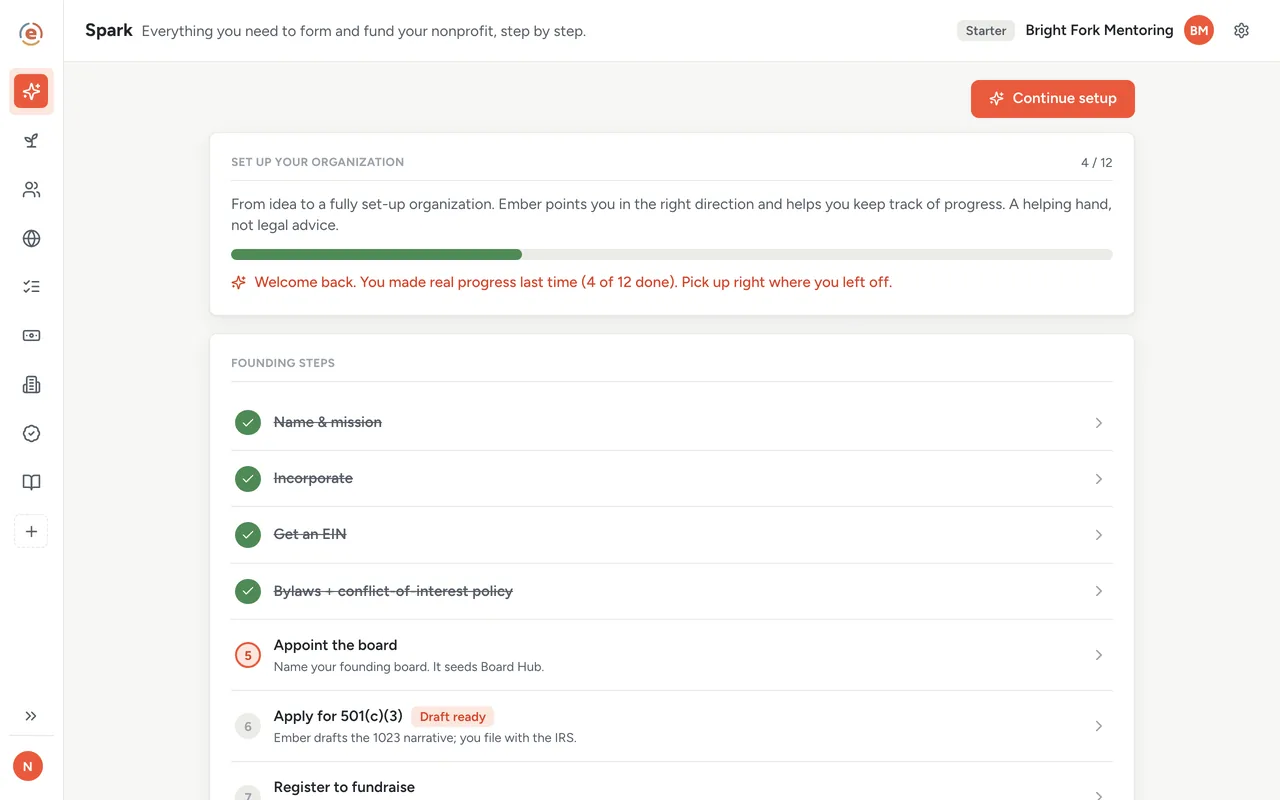
Twelve steps, four done, two drafts ready to adopt. Demo data. Incorporate in your state
Step two is a list of all fifty states and the territories. Pick yours, say Texas, and you get the office that handles the filing and a File in Texas link. Your choice is saved, so the fundraising registration step later on already knows where you are. File the paperwork on the state's own site, then mark the step done. The Texas guide covers the fees and the form.
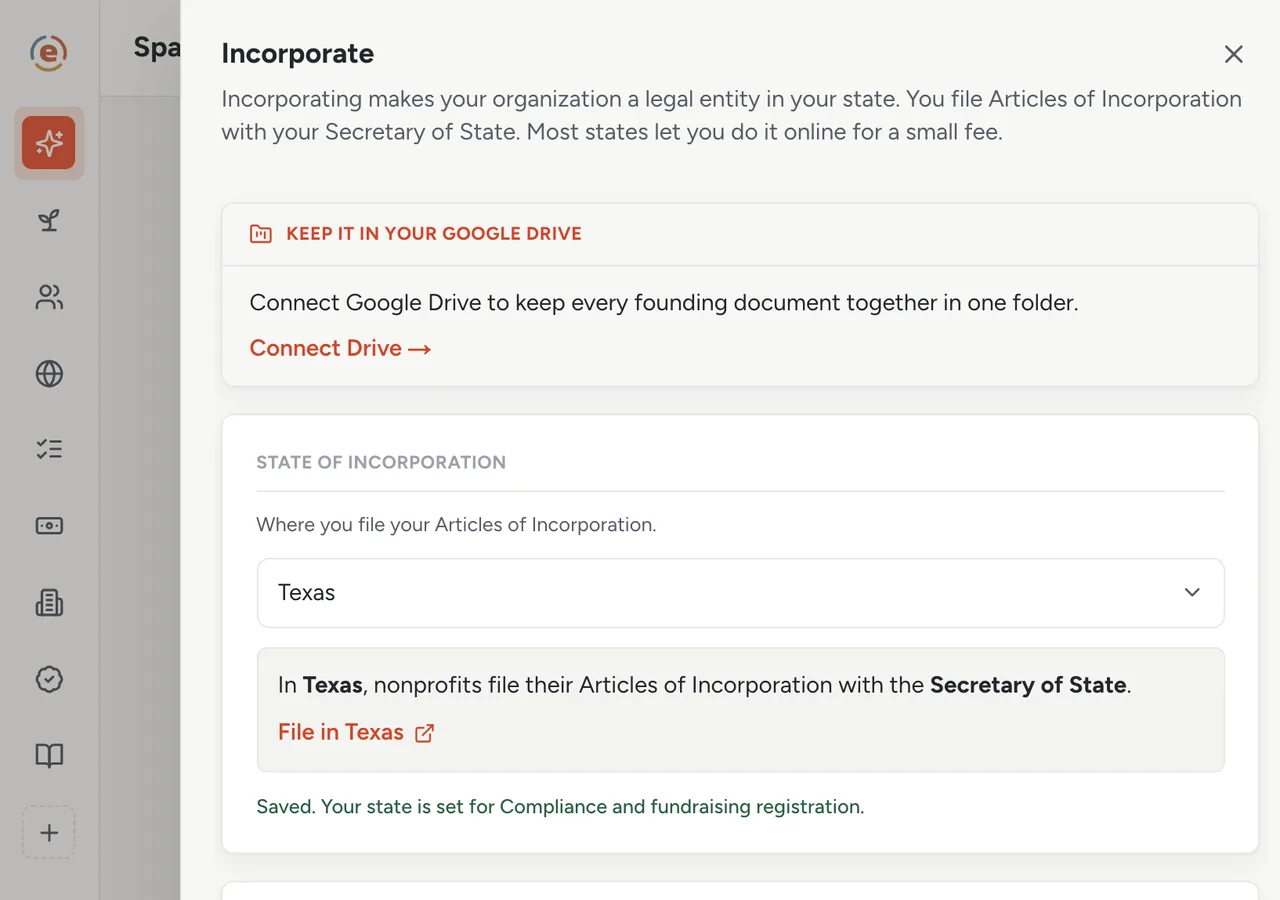
Pick the state once. Compliance and fundraising registration inherit it. Demo data. Get the EIN
The IRS hands these out online, free, the same day. Step three links you straight there and saves the number when you come back with it. How to get an EIN is the short version.
Adopt bylaws, with a conflict-of-interest policy inside
Step four gives you a draft of bylaws to start from, with the conflict-of-interest policy the IRS expects to see alongside them. Read it, change how often the board meets and what you call the officers, and tap Adopt & mark done. If you have connected Google Drive, one button files the draft in a Founding folder as a Google Doc. You can upload the signed copy beside it. What bylaws need to say.
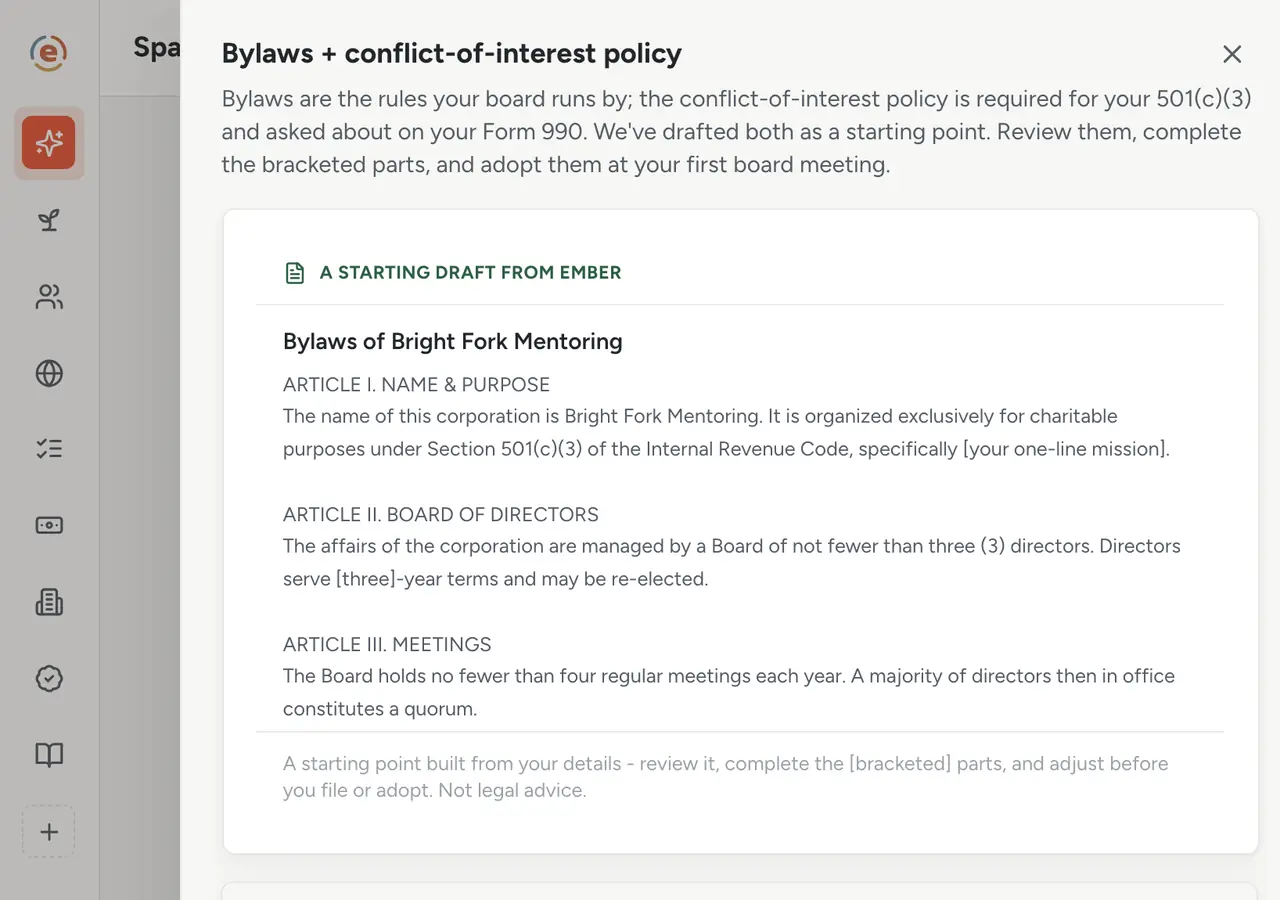
A starting draft, read and adjusted, then adopted. Demo data. Write the 1023 narrative from a draft, not a blank page
The 501(c)(3) step hands you a Narrative of Activities already drafted from the mission you typed in step one. Rewrite it in your own words; the draft is there to show you what one looks like. Whether you file the 1023 or the shorter 1023-EZ depends on how much money you expect to bring in. The step links to the IRS form itself. Marking it done puts your filing dates on a calendar, so the first 990 deadline exists somewhere other than your memory.
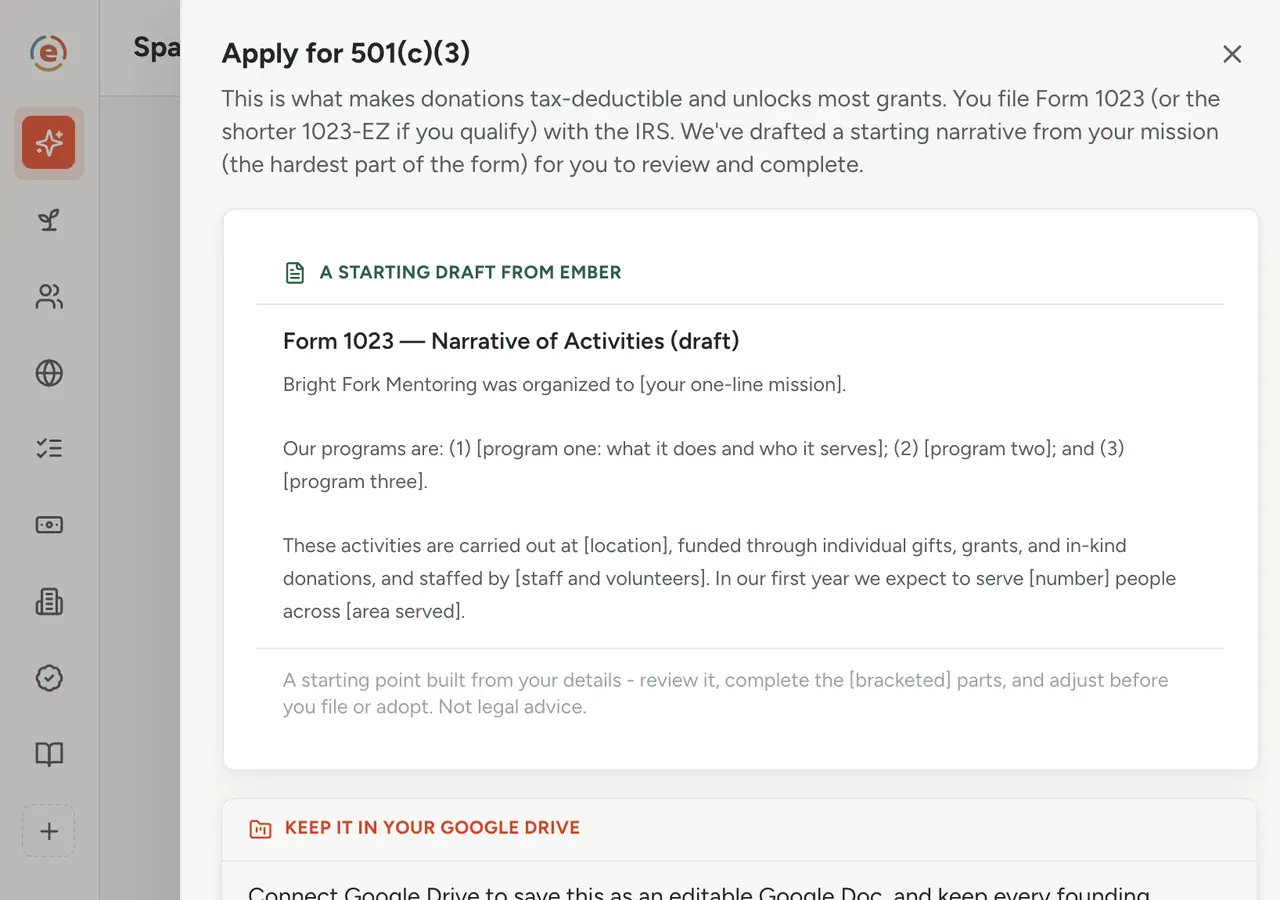
The narrative, drafted from the mission you typed in step one. Demo data. The bank, and the resolution the bank asks for
A bank will want a signed resolution saying who is allowed to open the account. Step ten has one written for you. Adopt it, print it, take it in with you. Step eleven is bookkeeping. Step twelve sets your fiscal year and your first program, and finishing it creates that program in Ember and starts your compliance calendar.
Who does what
If you are the founder
You have the order, the reasons, the official links, and a draft wherever a document is needed. You still file everything yourself. You are not guessing.
If you are one of the first board members
Step five is where you come in: an invitation to a board seat, and bylaws to read once you accept.
If you are the accountant helping a friend
Steps ten to twelve are yours: the bank resolution, bookkeeping, the fiscal year. Everything before them is already saved where you can see it.
- An idea, a couple of people, and no lawyer on retainer.
- A wish to do the steps in the right order and know why each one exists.
- Documents you would rather adjust than write from a blank page.
- A founder who wants the org to exist in one workspace by the time it exists on paper.
What it costs at this size
An org with no budget yet sits in the Starter band: $0, every app, unlimited users. The founding checklist, the drafts and the public page are all part of it. State filing fees and the IRS user fee are paid to them, not to Ember. See every band.
Free templateHow to start a nonprofit
The long-form guide behind the checklist, with the fees and the forms by step.
This is general information, not legal advice. Ember's starting drafts are starting points, not a lawyer. Forming a nonprofit and applying for tax exemption have state and federal rules that change; check them with your state, the IRS, or an attorney before you file.
The Ember tool for this stepEmber Spark
A 12-step founding checklist that writes each finished step into the rest of your workspace.
Sources: IRS: applying for tax-exempt status and get an EIN, read 3 September 2026. The org and figures on this page are an invented example; Ember has no customer data to report yet. Product behavior is described as built on 3 September 2026 and re-checked at each release.